Come hear a master of fingerstyle guitar
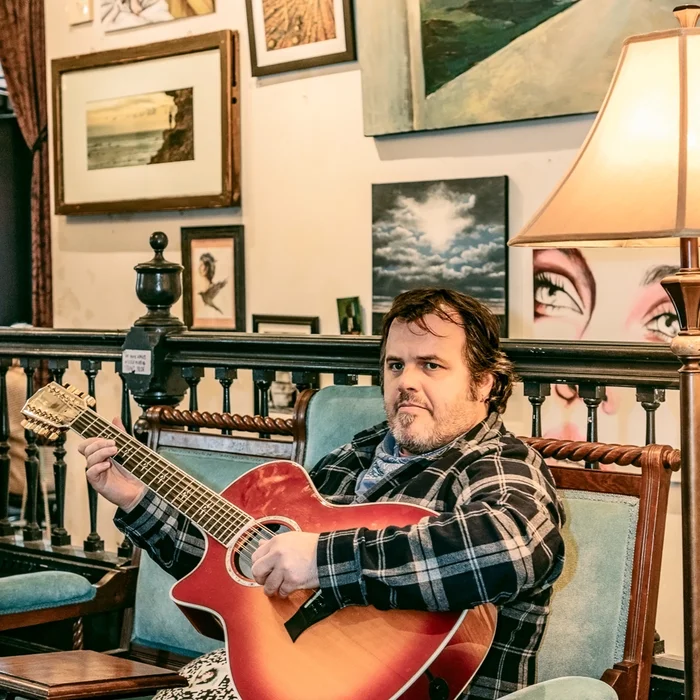
Adam Karch has quietly built one of Canada’s most respected roots and blues careers by following his own musical compass rather than chasing trends. Based in Montreal, Karch has earned acclaim for his masterful fingerstyle guitar work, warm vocals, and a sound that effortlessly blends blues, folk, country, and Americana influences. Whether performing solo or with a full band, he brings an authenticity that feels both timeless and refreshingly modern.
Over the years, his music has taken him across Canada and beyond, earning awards, loyal fans, and the admiration of fellow musicians. Yet beneath the polished performances is a storyteller, road warrior, and lifelong student of music whose journey is filled with unexpected detours, memorable characters, and the kinds of experiences that rarely make it into a formal biography. He plays Ottawa Bluesfest the night before he plays The Cove Inn patio stage on Thursday, July 16 from 5-8 pm. Details and reservations here.
Seamus Cowan: Every musician has a song they wish they’d written. What song makes you think, “I can’t believe somebody beat me to that one,” and why?
Adam Karch: For me, it's Hallelujah by Leonard Cohen. Every time I hear it, I'm reminded how a song can be both deeply personal and universally understood. The melody is deceptively simple, but the emotional depth is endless. It's the kind of song that feels like it has always existed, which is probably the highest compliment you can give a songwriter.
Q: You’ve spent countless hours on stages, in studios, and on the road. What’s the funniest or most bizarre moment that happened just before a show that the audience never knew about?
Adam: One of the funniest things that ever happened to me before a show was at a festival where I was performing a live soundtrack. Earlier that day, I had my capo with me, but after grabbing a bite to eat, it vanished. We searched everywhere—backstage, dressing rooms, equipment cases—but it was gone.
With showtime fast approaching and no replacement in sight, we had to improvise. A stagehand volunteered to stand beside me, and every time I needed a capo for a song, he'd come over and press his index finger across the fretboard where the capo should have been. Then he'd just hold it there for the entire song.
I'm not exaggerating when I say he became a human capo for nearly an hour.
The audience never knew what was happening. From their perspective, it probably looked like he was helping with some technical aspect of the performance. In reality, he was standing there heroically clamping down on my guitar neck song after song. It remains one of the most ridiculous—and strangely effective—examples of musicians solving a problem on the fly that I've ever experienced.
Q: Montreal has such a unique musical personality. If the city itself were a guitar, what would it look like, sound like, and who would be playing it?
Adam: Montreal would be a well-worn vintage guitar covered in stories, stickers, and scars. It would have a warm, woody tone with just enough grit around the edges. It could play jazz at midnight, folk at sunrise, and indie rock all afternoon without missing a beat. As for who'd be playing it, I think the city would play itself—every neighborhood contributing a different chord to the song.
Q: Is there a musical habit, superstition, or pre-show ritual you’ve developed over the years that would surprise people who know you only through your music?
Adam: I'm not particularly superstitious, but I do have a ritual of taking a few quiet minutes before every show. No phone, no conversations, just a chance to focus and remember why I'm there. People often imagine performers are getting hyped up backstage, but I usually do the opposite—I try to find a moment of calm before stepping into the spotlight.
Q: Imagine you could invite any three musicians—living or dead—to a late-night jam session in a small Montreal café. Who gets the call, and what’s the first song everyone ends up playing together?
Adam: That one's easy. Kelly Joe Phelps, Taj Mahal, and Doc Watson.
I honestly don't know what the first song would be. The truth is, with those three in the room, it almost wouldn't matter. Whatever somebody started playing, we'd just follow it and see where it went. That's where the magic would be.
For me, those musicians represent such a complete circle of musicianship. Kelly Joe Phelps brought a depth and spirituality to the guitar that still moves me. Taj Mahal embodies the living history and joy of the blues, always looking forward while staying rooted in tradition. And Doc Watson was simply one of the most gifted and influential acoustic musicians to ever pick up a guitar.
To sit in a small Montreal café with those three and trade songs until closing time would be a dream. I think I'd spend as much time listening as I would playing.
Posted: Jun 18, 2026