Building a bridge between generations: Jenn Grant brings 'Queen of the Strait' to life
The Northumberland Strait rests in the southern Gulf of the St. Lawrence, dividing Prince Edward Island from the northern face of Nova Scotia and New Brunswick. It’s an idyllic stretch of the gulf, home to the Confederation Bridge, windswept red sandy beaches, and waters shallow and warmer in the summer than any other bodies of Atlantic waters north of Virginia.
For multi-award-winning singer-songwriter Jenn Grant, the strait is a passage marked by grief and heavy with emotion, synonymous with an especially challenging period of her early life. On her latest record, Queen of the Strait, Jenn dives into the waters to retrieve a piece of her family history.
Ever since her 2005 debut Jenn Grant and Goodbye Twentieth Century, Jenn’s never been a stranger to the interpersonal, but Queen of the Strait is something new. Where her previous records are characterised by poetic lyrics that sway into the metaphorical, the new record strips off the varnish as she shifts her focus to her family, her childhood, and the painful start of a new life divided between two homes after her parents’ separation.
But despite its often-raw subject matter, Jenn approaches these memories with tremendous humanity and affection, reflecting on her family as she raises her own. It’s the kind of record that feels like a photo album or a slideshow, each song capturing a specific memory and rendering them in rich, vividly coloured detail. The opening song, “Jim Cuddy Dress,” is an affectionate portrait of her late mother, describing a chance meeting with the Blue Rodeo frontman as she accompanied Jenn at the 2012 Junos, just weeks before passing from breast cancer. “I Hate the Violin,” on the other hand, describes the difficult decision to give up the family dog in the face of impossible vet bills.
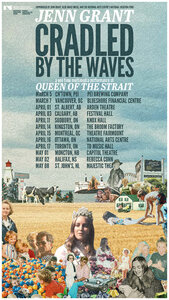
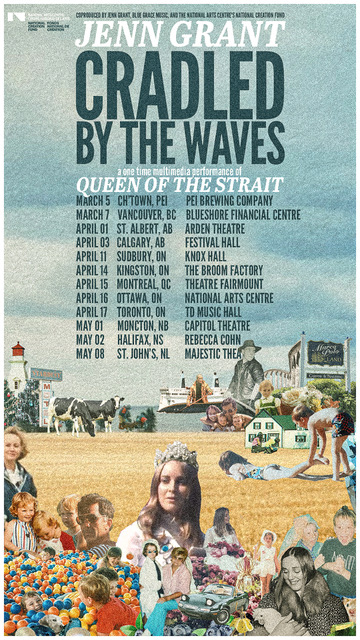
A special album deserves a special tour, and as Jenn takes Queen of the Strait on the road, she brings along with her a few twists on the live show. The tour, dubbed Cradled by the Waves (a translation of the Mi’kmaw word “Epekwitk,“ and the source of the name of the strait’s passenger ferry Abegweit), is a multi-media experience, where Jenn and her cast explore the album through a blend of music, theatre, film, and dance.
This is all very new to Jenn. Though she’s no stranger to the stage, her performances are distinguished by her off-the-cuff chats and free-flowing banter. When we contact Jenn, she’s home in Nova Scotia on a brief break between performances. She’s played the show a small handful of times, and though it’s as new to her as it is for her audiences, she’s keen to discuss the production, the album, and what people can expect from this one-of-a-kind tour.
It's very striking to hear such a personal record at this point in your career. It digs into your past in a very pointed way. Can you tell me a little bit about the intention behind the record?
I wrote a lot of songs across a few years in three bursts of writing, so there was a lot of different kinds of songs. Like, there was 41 songs, I think, before we started recording. But then there sort of became this interest on my own behalf. I was noticing I was starting to write from a really personal perspective and started sharing things that had happened to me or that I gone through in my life or as a kid. And I was like, oh, I think these are better. I think that my life has been very colorful and there's been a lot of different experiences. And so I feel like I'm coming at it from a perspective now where I'm looking at it, you know? I'm not in it. So it's a healthy place for me to be in to write about that stuff.
I just think that it's kind of my job as an artist to help people connect to their own stories like that. And so that's what I'm trying to do with this record and with the show.
Why is now the time to tell these stories?
I think there's definitely a connectivity happening. Whereas I had these two kids who are five and a half and seven, and when I was that age and my brother was 22 months younger than me, our family was going through a lot of stuff. The older I get, the more I connect to my mother. Even though we were really close, we were really, really good friends.
I think I've changed a lot in the last couple of years. There's activism, like not putting a record on Spotify or things like that, which are really going against the grain and you're not following the path that the industry is recommending. I think there's something really grounding in that and I feel more self assured and I feel more confident. And I'm not looking for approval in any way, so I feel like it's a good time for me to just be really honest about a lot of different stuff.
It feels like each song is a very distinct and very thoroughly colored story. “Jim Cuddy Dress,” the opening track, is a very clear example of that. But as you go through the album, songs like “Take Me to the Movies” and “I Hate the Violin,” these are such deeply realized stories and as a listener, it shows a degree of confidence and experience. So hearing you refer to reaching this point in your career where you're comfortable to tell these stories, I think it comes through pretty clearly on this record.
That's so nice to hear. We bought a cottage in 2020 in PEI that we share with my sister in law and her family. And I was on our last trip before making this record, I was riding in the car all the way to PEI, and when we got into the cottage, I couldn't put my stuff away. Like I had to sit down and write. And there's been this thing about Prince Edward island. There's always been some sadness and memories of hard things attached to that place. And I have been developing my own relationship with Prince Edward island because I have this place there that I go to, and it was a place that I found gave me peace in the last couple of years when I really, really needed a break from just watching the world around us in such a difficult space with Palestine and different stuff like that. And so it just kind of felt like this really beautiful thing to just dig into my own childhood and try to share the story, because I think there are some interesting stories there. And I love the idea of being connected to my kids and sharing these types of things.
I think that's such an interesting “use” for a record. I feel like that comes off very utilitarian, but it's like you’re building a bridge between generations with this record.
Yes, and I want it to be useful. I've written lots of songs that are just colored in metaphor and really connect to emotion, and I know how to do that. But then as an artist, I want to push myself, and I want to take risks and grow so that I can continue to grow as an artist and this person, and be of value to someone. I want to make songs and make a record and put it out, I want it to be useful for the listener, you know? I want it to be engaging. I wanted to make them think or maybe grieve well or tap into their own selves.
It's been interesting to me to hear such a personal record following Champagne Problems, which is this exceptionally collaborative record. Like, there're features from almost every corner of the country. Is there a connection between creating such a collaborative, expansive record and then leading directly into something that's so localized to PEI, and so localized to your own past?
Yeah, the idea for Champagne Problems was to celebrate Canadian artists and the country, in a way, musically. And the end bonds and friendships and sort of do that with intention and joyfulness. I love collaborating, but it really also made me miss just being alone and being a songwriter by myself. There's often a push to write with other people, and it can be really expansive and you can get really great stuff out of it. But there is something just so special about just digging into your own stories and just being alone with it. And I was kind of craving that. I was missing just writing something that was really just of my own.
Speaking of collaborations, this tour is also very collaborative because it's this combination of music and film and theater and dance. Can you tell me a bit about putting this all together? How did this come to be?
There's a lot of different people involved. And there were several different workshops. The first one was in Ireland with my Artistic Director Julie Kelleher, and then a dancer and actor, Jade O'Connor, who worked on some development with me. And then there was a week in PEI in the fall with the band and projectionist Jose Garcia-Lozano from Guelph. And then there was a couple days me and Tanya [Davis] had here in Nova Scotia. And then there was this final workshop we had in Dartmouth at the Sanctuary of the Arts for a week right before the shows began. But basically, it is a collaborative thing.
I collected footage that I could find of my childhood across the last year, which I've been working with Jose on for projections and stuff and to help tell stories. And my brother, Daniel Grant, who is a cinematographer, filmed new footage to go along with this as well. The album is dedicated to my brother, and a lot of the stories are really just our journey together as brother and sister, so he was integral to the creative development as well, visually. And Tanya, she's kind of represents different versions of me, different versions of women, of my mother, helping me to tell stories, too.
I don't know if you've ever heard of this thing that I made. It's called Jennytown. It's this YouTube show that I created during the pandemic, and it's just like me being silly goose, you know, cooking and baking and doing all these crazy things. And I just developed this thing in the pandemic, but there's elements of that in the show, as well. There's a script to it, which I've never done, so it's very much leaning into a theater world as well, which is super exciting for me and it was scary for me. I'm so used to never saying the same thing twice and doing a lot of off the cuff banter. My shows have become really settled into that rhythm of people laughing and people crying and a weird mix of emotions. And it's still leaning into that very much, but I was afraid, if I was going to be able to do something scripted. And now I’ve done it two times already.
Within a script there are parameters, but I'm still free to explore some of the spaces off on my own. And so that part of me and the show and that connection with my audience is not lost. So that was one of my fears and hopes that I'd be able to keep that in the show, and I have. So yeah, it's a fun. It's fun and it's explorative.
Now what's the response been like so far from the two shows that you've had?
We found the response has been great so far. There was a few things from the PEI show that we tweaked for the Vancouver show, so it is still in development, it feels like, but at an exciting stage where we're ready to present it. But I'm still kind of curating it a bit. So I think that might continue throughout.
Whenever I do a normal tour, it's that similar type of process where after every show it's like, okay, well how did that go? And it's like you're massaging it into something. But just to a greater extent because you are collaborating with different people and there’s discussions around it more so than there would be normally.
Jenn brings the Cradled by the Waves to the Broom Factory on April 14. Tickets and details available here. stream 'Queen of the Strait' on Bandcamp or anywhere you stream music that isn't Spotify.
Posted: Mar 31, 2026