Six applicants awarded in the Isabel Bader Centre for the performing arts 2025-2026 IMAGINE Arts Incubator
Six successful applicants have been selected for the 2025-2026 IMAGINE Arts Incubator Program, hosted by the Isabel Bader Centre for the Performing Arts at Queen’s University.
The IMAGINE Arts Incubator Program was developed in 2020 to foster creativity and innovation and to enable Kingston and national professional artists and creators to explore, invent, collaborate, and produce. The program supports artists and their projects through the granting of venue space, production staffing, and artist honoraria.
“The Isabel Bader Centre for the Performing Arts is committed to supporting creative work that amplifies diverse voices, embraces artistic innovation, and engages thoughtfully with the social and cultural realities of our time,” says Gordon E. Smith, Director of the Isabel Bader Centre for the Performing Arts. “The 2025-2026 IMAGINE Arts Incubator projects exemplify these values, and we are thrilled to support these artists as they bring bold, meaningful new work to life.”
Projects selected for the 2025-2026 IMAGINE Arts Incubator Program include audio and video recordings and creator residencies that explore migration, memory, identity, accessibility, and the amplification of underrepresented voices. Together, they reflect a commitment to artistic innovation, cultural equity, and deeply personal, immersive storytelling.
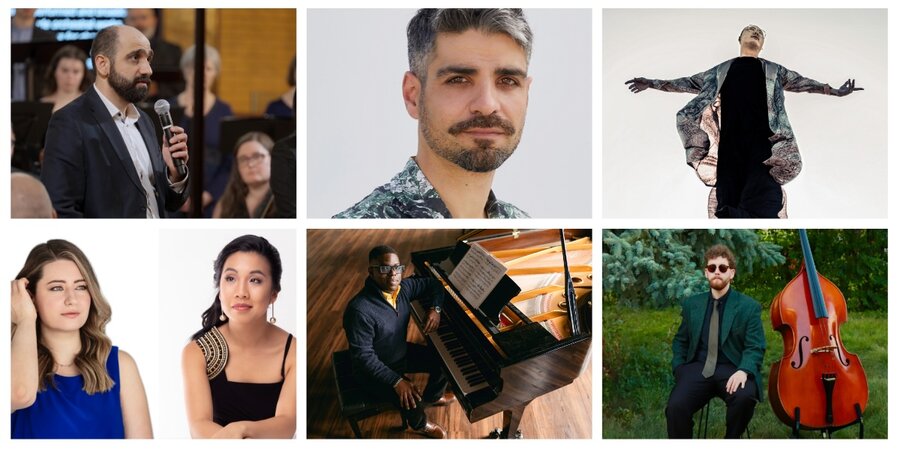
The 2025-2026 IMAGINE Arts Incubator artists are Saman Shahi, Ricard Soler Mallol, Daniel Hamin Go, Silvie Cheng and Isabelle David, Luke Welch, and Oscar Evans.
The 2025-2026 IMAGINE Arts Incubator Program is made possible through the support of Bader Philanthropies and the Isabel Bader Centre for the Performing Arts.
2025-2026 IMAGINE Arts Incubator Project Listings
Saman Shahi – Fragments
Audio Recording
The goal of this residency is to record a 19-minute work for choir and String Quartet titled "Fragments" by Juno- Nominated composer Saman Shahi. This work was commissioned in 2022 by the Cantabile Chamber Singers in Toronto, and received its world premiere in 2024 with the CCS and the Ton Beau String Quartet under the direction of Cheryll Chung.
This work delves into the anxieties, memories, and the dream world of a refugee, and searches for meaning, hope and light in spite of harrowing circumstances. Nika Khanjani, the poet for this work, interviewed several refugees from different walks of life and geographies, and crafted their stories and testimonial into a powerful poetic expression.
Aside from the high acclaim after its premiere, this work has already received international recognition by being performed at the prestigious Lucerne Festival 2025 in Switzerland, and also being selected by the ScoreFollower 2024's highly competitive call for scores in 2024, which speaks to the impact and strength of the work.
Ricard Soler Mallol – The Last Quartet
Creator Residency
This project will support the creation of the multidisciplinary performance The Last Quartet, at the intersection of music, documentary, and visual theater.
Prelude: At the age of 14, at the conservatory, I performed a Baroque sonata by the French composer Doucet. I had carefully prepared it with my teacher and studied it intensely at home. After my performance, my teacher, with a half-smile, said: "You played it as well as you could. You cannot do better, because it is not technique you lack, but life itself. You still need to live more in order to interpret this work with its full depth." This moment left an indelible mark on me, though I wouldn’t understand its meaning until decades later: music is not played only with notes, nor is it improved solely through study and practice; it comes from the depth of life itself. —Ricard Soler Mallol
In a poetic and immersive scenography, chairs await the arrival of the four senior classical musicians. Upon entering they prepare their instruments while the first question is projected onto a tulle screen: “What composition would you play if it were your last quartet?” From this starting point, documentary footage that our collective will capture ahead of time—conversations with the four musicians—interweaves with live musical performances. Built around a unique scenic device combining music and documentary with dramaturgy developed during the creative process, The Last Quartet invites audiences to immerse themselves in the melodies of these passionate musicians, as well as the experiences, thoughts, and reflections that emerged during the preparation of this unique moment. Reflections on the passage of time, pursued dreams, illusions, and crucial decisions made in the past; intersecting perspectives of a single generation on life and their passion for music. Musical conversations, existential discussions.
Daniel Hamin Go – Dear Father
Video and Audio Recording
Dear Father turns inward: an intimate, multi-genre requiem for a pastor’s queer son, created for anyone navigating the complicated intersections of family, faith, identity, and loss. Built around solo cello, cello and piano, choir, string quartet, mixed ensemble, and electronics, the album weaves existing works and new compositions into a unified narrative of grief, rupture, reconciliation, and hope. Repertoire includes movements from John Rutter’s Requiem and Eric Whitacre’s The Sacred Veil, Messiaen’s “Louange à l’Éternité de Jésus,” and new cello arrangements of Chopin’s Nocturne in C minor and well-known hymns such as “Goin’ Home,” “When Peace Like a River,” and “Blessed Assurance.” These anchor two original works: "Dear Father" for voice, cello, and string quartet, and "The Voices" for layered voices, electronics, and solo cello. Dear Father marks Daniel Hamin-Go’s debut as a composer and producer, integrating classical, choral, gospel, CCM, folk, and electronic practices into a human-first album that can live both on record and in a flexible touring format for concert halls and open-hearted faith communities. Through Dear Father, the aim is to create a deeply personal yet widely resonant work that invites audiences into nuanced conversations about shame, healing, freedom, joy, and the universal human longing to belong.
Silvie Cheng and Isabelle David – Duo BelleVie
Video and Audio Recording
Duo BelleVie launches its first large-scale video recording initiative to enrich the repertoire for piano partnership (both four-hand and two-piano) and to meaningfully expand representation within classical music. As an all-women duo, they are committed to inclusive programming that champions the artistry, range, and historical significance of works by women and Canadian composers. Their lived experience as Canadian women in a field where female composers were, and are still, seldom centered motivates this project and reflects their belief that representation is essential to the equality our society continues to pursue. This inaugural video series will include works by Jocelyn Morlock, Amy Beach, and Germaine Tailleferre, as well as Duo BelleVie’s new arrangement of “Rhapsodie canadienne” by Auguste Descarries. These pieces—all of which remain underrepresented on concert stages and in existing recordings—offer rich intersections of cultural identity, heritage, and artistic lineage. By producing high- quality, widely accessible video recordings, this project aims to create landmark interpretations that inspire future recital programming, spark scholarly interest, and serve as educational resources for performers and presenters alike. Ultimately, Duo BelleVie advocates for a more inclusive musical landscape, one in which women’s voices are celebrated as an integral and vital part of the classical and contemporary canon.
Luke Welch
Audio Recording
This project involves a solo classical piano album which will feature repertoire from a variety of Black classical composers. What makes this album of special note is that there will be a singular focus on the presentation of Black female composers from the late 19th up to the mid-20th century—spanning from the earliest published solo piano work by a Black female composer, up to music from the recent historic discovery of Florence Price's previously unpublished manuscripts. The complete list of proposed composers to be included on this recording include Montague Ring (Amanda Aldridge), L. Viola Kinney, Estelle Ricketts, Francisca (Chiquinha) Gonzaga, and Florence Price. In addition to Luke’s personal goals of continuing to expand his repertoire from both the "traditional" classical music canon as well as exploring the music of lesser known (in present day) composers, he has been encouraged by audiences, concert promoters, and radio broadcasters to continue along this path of performing and recording the music written by Black composers. The concept involves the reformation of establishing the due credit these composers deserve—each and all acknowledged by their contemporaries as being among the very best in their respective crafts during their lifetimes, yet unfortunately subsequently reduced to footnotes or obscurity after their passing. The quality of their musical output is worthy not only of mention, but also presentation—which is the primary focus with the hope that others will hear this music and be inspired to learn and perform it as well.
Oscar Evans
Audio Recording
This project is the recording of free improvised, jazz-inspired chamber music during which all participating musicians will be blindfolded. Being blindfolded will give each of the diverse musicians a glimpse into Oscar’s experience as a blind musician and together they will push the boundaries of improvised music by listening intimately to each other as they take their collective musical creations in unforeseen directions. Musicians have been selected to collaborate on this project based on their technical and improvisational skills as well as for the variety of their instruments. Instrumentation will be arranged to include intimate, delicate duets to large ensembles. The group includes lesser seen instruments such as didgeridoo, hurdy-gurdy, and tabla. This project will create a meaningful body of work that has strong ties to Kingston, to its musicians, and to Oscar’s life as a blind musician.
Posted: Feb 3, 2026