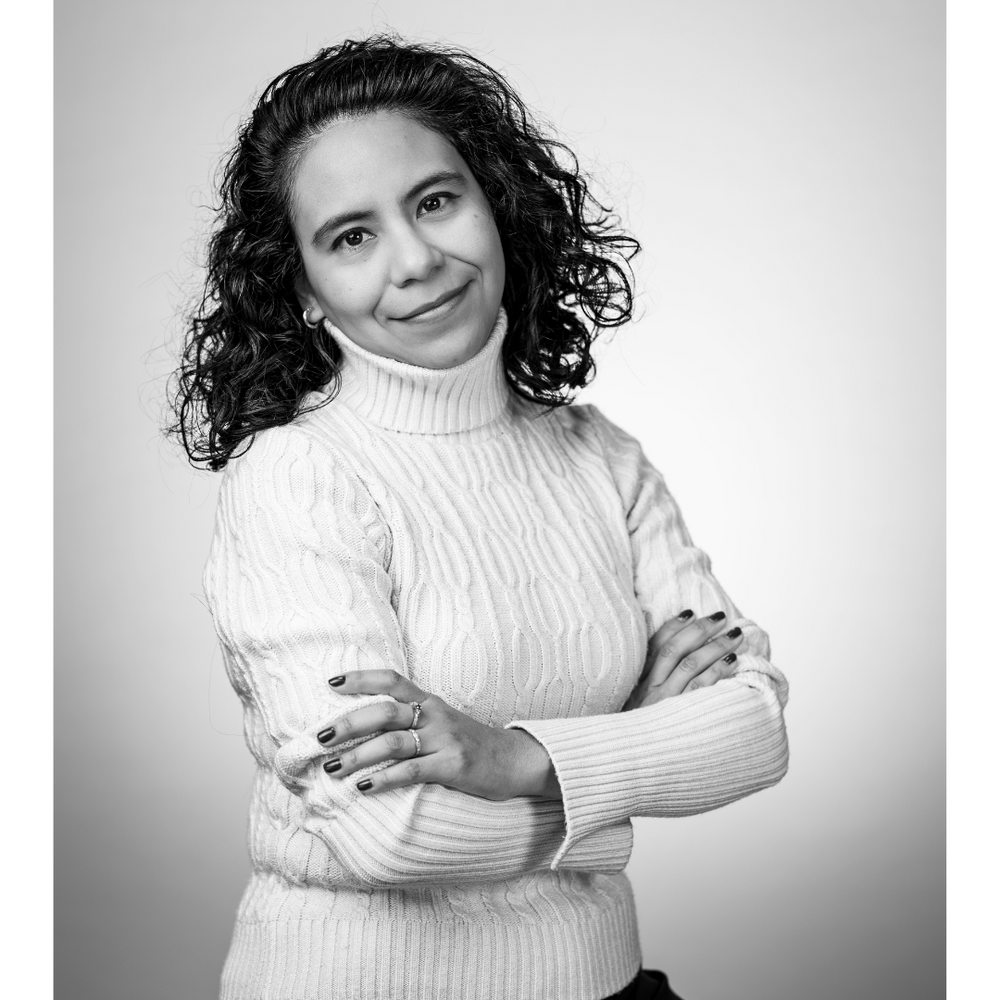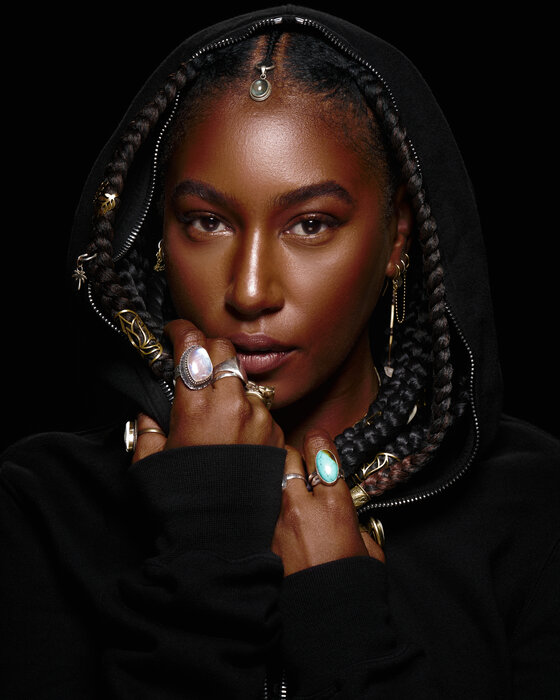
Surrendering to instinct: Embracing the freedom of music with Dominique Fils-Aimé
The sun is shining in Montreal as singer-songwriter and jazz vocalist Dominique Fils-Aimé prepares for the eventful month ahead.
In just a few days, she will release her fifth record, My World Is The Sun, and kick off a three-month-long tour that will take her and her band across nine countries for 21 shows, including a stop in Kingston at the Isabel Bader Centre on February 27. Dominique’s excitement and positivity pour through the phone within moments of the call connecting, but today she’s enjoying a brief period of respite at home among her people and her many plants.
“I just want to hibernate,” she says. “I'm very excited that I get to be at home a little, clean my house and see some friends, see my mom.”
The new record is the second installment in a trilogy of records, and the follow-up to Our Roots Run Deep, an album that earned Dominique both a JUNO for Vocal Jazz Album of the Year in 2024 and the 2024 Félix Award for Best Jazz Album at the Association du disque, de l'industrie du spectacle québécois.
My World Is The Sun picks up where Our Roots Run Deep left off, exploring shifting landscapes rich with harmony. Her songs have a tendency to take on lives of their own, effortlessly growing and winding from idea to expression. Her latest tease of the record, “The River”, evolves from soulful a capella to moody, bluesy piano, to waves of choral harmonies before building to hand drums and trumpets, tinged with New Orleans flair. There’s a free-flowing quality to her music, and that fluidity is key to both her sound and her philosophy.
Dominique leans into intuition in both her songwriting and performance, tapping into the free spirit of jazz and trusting in herself and her collaborators. Her approach embraces freedom of expression, freedom of sound and style, and freedom from norms and expectations. And that’s where the audience comes into the picture.
Peter: A big change to your live shows is that you've requested that audiences abstain from applause.
Dominique: Yes. Well, I like to frame it so that people don't feel like I'm giving them orders. I present it as there is very little room for applause in the show because we built it in the way that the songs are all interconnected and linked, so that people can really sit down and sink into their seat and just let the music go through them. Because it's the part that I find the most fascinating and magical about music, the idea of frequencies going through all of us at once and vibrating together. And I used to be very disturbed by the concept of singing a song, then applause, then I talk a little, then applause. Like the repeated interruption of the music. When in my head, I see my show as a journey, and a moment that I want people to really be able to allow themselves to travel in their head, close their eyes, and get in a kind of meditative state. And I feel that whenever there's this back and forth that happens, not comfortable with it. And I'm thinking that it's not aligned with the intention behind the music. So we have formatted the show to look more like what we're trying to create and to be more connected to the actual reason we're making music.
Peter: I like that concept because your music has this very intuitive flow to it. So the idea of incorporating that intentionally into the show, I think that that would make it very exciting for audiences.
Dominique: Yeah. But I remember at the very beginning when we started doing this, people were feeling a bit taken aback by the fact that there was no room for them to applause. And I found it interesting. There is also a desire within the music and the freedom that art gives us to question everything, and this is one of the things I wanted to question. And I'm kind of hoping that by being confronted with that change or that idea and realizing, oh, this is just a social construct that doesn't have to apply everywhere, that we are free to decide if we want it or not.
Perhaps if I go further in everyday life and encourage everyone, and myself, being reminded that we're allowed to question everything because perhaps some things belong to the past, you know? And when I looked into where applause came from and I saw that it used to be a way to vote in ancient Greece, that's the joke that I would tell them. Like, you know, now I know where it's from, and I realized it has nothing to do with my show. So instead, you can just sink in your seat and take in the vibrations, close your eyes. Let's go for a trip for a minute.
Peter: How have you found that audiences have responded to that? Do you find people are especially engaged in the show?
Dominique: The funny thing is that, to me, I do see people sometimes move a little in their seat, but I feel like my favorite engagement is when I can see someone really closing their eyes and I can tell that they're comfortable in their seat. In French, there's a word, to déposer. It's like you abandon yourself in that space, and you're just anchored in your seat comfortably. Being able to be in the moment, physically and mentally, all in. And that is something I love. And also, if someone starts to have a few tears coming down, I guess it's the only time I'm happy to make people cry.
Peter: It's the right kind of tears.
Dominique: Yes, absolutely.
Peter: Now in your music, and in a lot of jazz in general, it really takes on a new life in that live setting where there's space to explore, and you have this opportunity to work with the chemistry of your band. How much does the setting and the audience impact the performance for you?
Dominique: I feel like regardless of [the audience], there's always got to be that chemistry between us that is untouchable because we love each other, you know? We love music, we love each other. I am so fond of my band because each of them brings something that is genuinely from the heart. There is no room for ego. We're truly trying to create something for… the musical moment. So I've never felt like anyone was trying to step on each other's toes or trying to take more space to be seen. So to have a band and a group that is at the service of the music and the experience that we're trying to provide is a huge key to that fun, that pleasure, the fact that we're all remaining in the now. No one is ever going on automatic pilot because anyone might improvise something unexpected at any moment. So you have to be here to follow and to adapt to it.
I do feel like perhaps since there is a connection with the public, depending on playing outside versus playing inside might bring different energies. Playing daytime or nighttime. Also when you're in a festival under the sun, sometimes we'll even adapt or have a bit more energy from the sun or be more upbeat, or when we're late at night in a quiet bubble inside a closed room, we'll dive more into the meditative and calming energy of nighttime. So I think the people and the setting and the time of day will definitely leak into the music.
Peter: Now, speaking of your shows, I've also heard that when going on stage, you'll encourage the rest of the band to try new things. How did you build that trust and rapport?
Dominique: It kind of started from the fact that we started touring more and more and we wanted to make sure that we were always remaining present, you know, because sometimes you do get tired when it's been maybe two, three weeks traveling. And I just recall when, like, maybe two shows in a row being kind of similar, and then right before the stage, throwing at them: ‘okay, everyone do something you’ve never done before.’ So it was a challenge. And then it remained that once in a while when we feel like there's a lower energy or we've been doing it for a few times in a row, just to remind everyone, okay, remember, we're supposed to surprise each other so that everyone is kept on their toes, you know? And it's been a lot of fun because there it keeps that idea of impersonalization, remaining alive and the show evolving and making sure that no two shows are the same. So everyone that sees a show sees a one-time connection between us that will never be reproduced identically ever again.
Peter: That's such a pleasure for an audience.
Dominique: Oh, and for the band, it's so much fun. We have the best job, honestly.
Peter: I'd like to ask you something that's a little more focused specifically on you. Listening through your music and also learning a bit about your approach to recording, one word that really came into focus for me was the word confidence. From the decision to go without applause in the shows, to even just opening your first record with “Strange Fruit,” which is a song made famous by the legendary Nina Simone. Those are some big shoes to fill, but in these big decisions, they continue to pay off. Like you're recording of “Strange Fruit,” it's such a fresh take on a song that has such a long lineage.
Dominique: Thank you.
Peter: So I guess my question is, where do you draw that confidence from?
Dominique: I've never even thought of it like that. So I appreciate that. I guess a big part of my journey has been about ‘I don't want to work, I don't want to think too much.’ We all do. But my life shifted from the moment that I surrendered to my instinct and to the signs that life brought to me. And eventually it turned from belief to a feeling of knowing. And it's like we always have that place in our heart, in our guts, in our soul, that points in directions or that tells us every moment, this is the right thing, this is the wrong thing. And following that, combined with the fact that I know what my message and my purpose is, or the mission that I chose, or was given to me, it makes it so that there is very little room for doubt or for caring what people think. I guess I care about how people feel and how we evolve as a whole. But I don't necessarily have those moments. Like, even the impostor syndrome left very quickly when I realized art belongs to everyone.
We're all creators, we're born. The first thing we do as kids is draw. And somehow society comes in suddenly judging who's good, who's not, when really all art is good because it's the process that matters. So from the moment that I let those notions properly sink to me and my music, it became a feeling that it's bigger than me, and that I'm just here to follow the path and kind of obey the instinct and go where it takes me. And by remaining in my artistic integrity, I think that's something that vibrates more than the physical material representation of it. Because when people pay attention, I don't have the most unbelievable voice, you know? I was self-taught. I often am off-key, but people are connecting with the emotion and the intention in the frequencies that I'm creating. And I think this is more important than anything physical or technical or even marketing or industry or anything. It's the art as the centre will always win.
Peter: I love the way you put that. Especially the notion of surrendering to instinct.
Dominique: It feels so good.
Peter: And that is also something I was thinking when going through your most recent two records. There's a lot of intuition at work. Have you had to develop that approach or was that sort of a skill that you've always had in your approach to music?
Dominique: It's always been there. I've always loved the arts in general. Though I did have a phase in my life where I started working a corporate job nine to five. I was working in psychological support for employees and I burnt out. And I feel like during that time, I was somehow doing what felt right as a purpose. But clearly I was not doing it in the right setting. And music was part of my therapy process. So when I started therapy after the burnout, I started also making music from instinct, just at night, whatever would come to me. And then eventually I discovered harmonies. That feels so good. And there's something about harmonizing that tickles my soul and brings me so much enjoyment. So I really followed what felt good and what brought me peace, what brought me a sense of well-being.
And I feel like that was the start of me discovering my personal musical style and continuing in that lineage of always being connected to the joy of it, to the freedom that it is. Because that's how I discovered that I was a jazz artist. It's as if I just discovered it, because by understanding and researching what jazz was about.
People were creating jazz from a place of liberation, from a place of complete freedom, from breaking out of what had been standardized and, you know, socially accepted, in a way. And it was a liberation that was artistic and social and a way of life. And that's something that really spoke to me. And that's how I understood that this is the place where that feels right to me, is a place where I would create completely free and from instinct so that I can keep the essence of jazz alive and share it with as many people as I can. Because it's something that does leak into your life. And arts and personal evolutions are completely interconnected and are practically one, really, if you choose to make art from that place where it's linked to your soul and your person. So the creative process really just evolved with my surrendering.
Peter: That is reflected in your albums. It's been interesting to go record to record, and with that first trilogy, you have this exploration of different styles of African American music. There's blues, there's R&B, and then there's jazz. And then on this next run of records, it's like you’ve used those first three to really define the style. And it sounds to me that the new records are exploring that style more deeply.
Dominique: 100% it is.
Peter: And you've also said that the new ones are a trilogy as well. Can you tell me a little bit about the decision for that format?
Dominique: I remember when I started the musical journey on a deeper level, I had just started, I was having a lot of fun, then suddenly someone approached me. As in, ‘Oh, I could make you a star. We could do this and that.’ And right away I could tell, okay, we're not aligned. So I continued doing my thing. And then I met my today-manager, and we sat down and we talked about our definition of success. And to me, it was being able to create completely free. And I don't need to live off it. I can have a job. I had a job in a coffee shop by then and I was happy. I was like, I just want to be happy and healthy and be free in my creation. The first thing he said, ‘I will probably not be able to make you live off your music, but I promise you that I will protect your integrity and make sure that you are creating something and leaving behind music that was completely yours and that was completely open and honest.’
So when we started, he said, ‘you have six months to think about what is the first project you want to do. Do you want to do a single? Do you want to do an EP, album, whatever. What topic, what style?’ And when I started exploring, where did my passion for music come from? And I dove back into my teenage years and my younger years. It was those musical styles that vibrated with me the most. It was jazz songs. It was blues. It was R&B, hip hop, all the musical styles that were created through those times of history that were very heavy. And realizing that music was the capsule to keep the emotional components of that history versus the history books that had the dates and the people and the time. So it became super clear to me that there was no way I could do this in one album or EP.
It had to be a trilogy, because I wanted to explore the blues and the water element of blues. The nighttime, the silence in the time of slavery, and the emotional heaviness that it was carrying. And then the jazz, to me, I saw it as the lava from a volcano. The fire of the freedom, liberation, burning everything so that you leave a more fertile ground behind to rebuild and grow new components to our society. And then the soul was the light. It was the breeze of fresh air, the new start, the ramifications of jazz, from soul to neo-soul to R&B to hip hop. So it felt so obvious that it had to be a trilogy, that I could see the colors, because I always feel like music has colors. I can see them. They're obvious, you know? I even painted every album before writing it so that I would connect with the frequency of the color.
And I do recall many people saying that you can't do that. You can only do singles now. People don't have the attention span, you know? And that felt like one more reason to do it. Like, I'm not trying to please everyone. I'm trying to make art that is honest with who I am and my vision, and whoever is willing to come for the ride. And I do believe, as humans, we want to connect on a deeper level. We want to connect long-term with each other. We're just being fed a lot of fast food when it comes to interaction, and everything has to be quick and now. But I love patience. I love taking the time to craft something properly. Just like we take the time to feed our plants with the water and the light and we get excited from every little leaf. I want to do the same and exist on a rhythm that is aligned with my soul and with my personal evolution.
Peter: I loved your comment about the process of connecting your music with color because visually, the records all have a very dominant color represented on the covers, and getting to hear your explanation, the red of Stay Tuned! and the yellow-gold of Three Little Words. There’s so much intention. They all make sense.
Dominique: And it's all frequencies. Music is frequency, color is frequency. So sometimes we kind of separate them when really I think they're one and the same. Everything is about frequencies.
Peter: So the new record, it's represented with this deep purple. What is the intention behind purple? What does purple mean for this record?
Dominique: So every color that I described, there's also the link to the chakra that is linked to that color. And the purple chakra is the crown chakra, so it's the one floating above our head. So it's kind of the extension of us in the virtual realm. There's also the continuity because I do feel like everything is cyclical. And the way that the first trilogy with the primary colors went, it started blue, red, yellow, and then for the new cycle, the yellow and the blue met through Our Roots Run Deep, creating green and the chakra of the heart, the nature, the plants.
My biggest inspiration, musically speaking, is definitely nature. And all my babies in my house, I have like 80 plants. And then for the purple, it was a meeting of the blue and the red where there is that notion of silence, but trying to break free from the heaviness and pain through the seeking of peace of mind and the freedom aspect of the jazz and [Stay Tuned!], that was a bit more on the physical realm, and the concept of freeing ourselves from the oppression now it's the oppression that we create for ourselves and seeking the personal freedom and liberation from our own state of minds, of our way of thinking. The patterns, the negative thought patterns that might impair our well-being. So I feel like the circle is continuing as a spiral that opens up and that from the more physical world, we're trying to step above that and find a way to exist in a place where we cater to the emotional, spiritual, soul aspect of our reality.
Dominique will take to the stage of the Isabel Bader Centre for the Performing Arts on February 27. You can find tickets here, and stream her latest single "Going Home" off My World Is The Sun on Youtube and Bandcamp.
Posted: Feb 7, 2026